How Each Connection Works

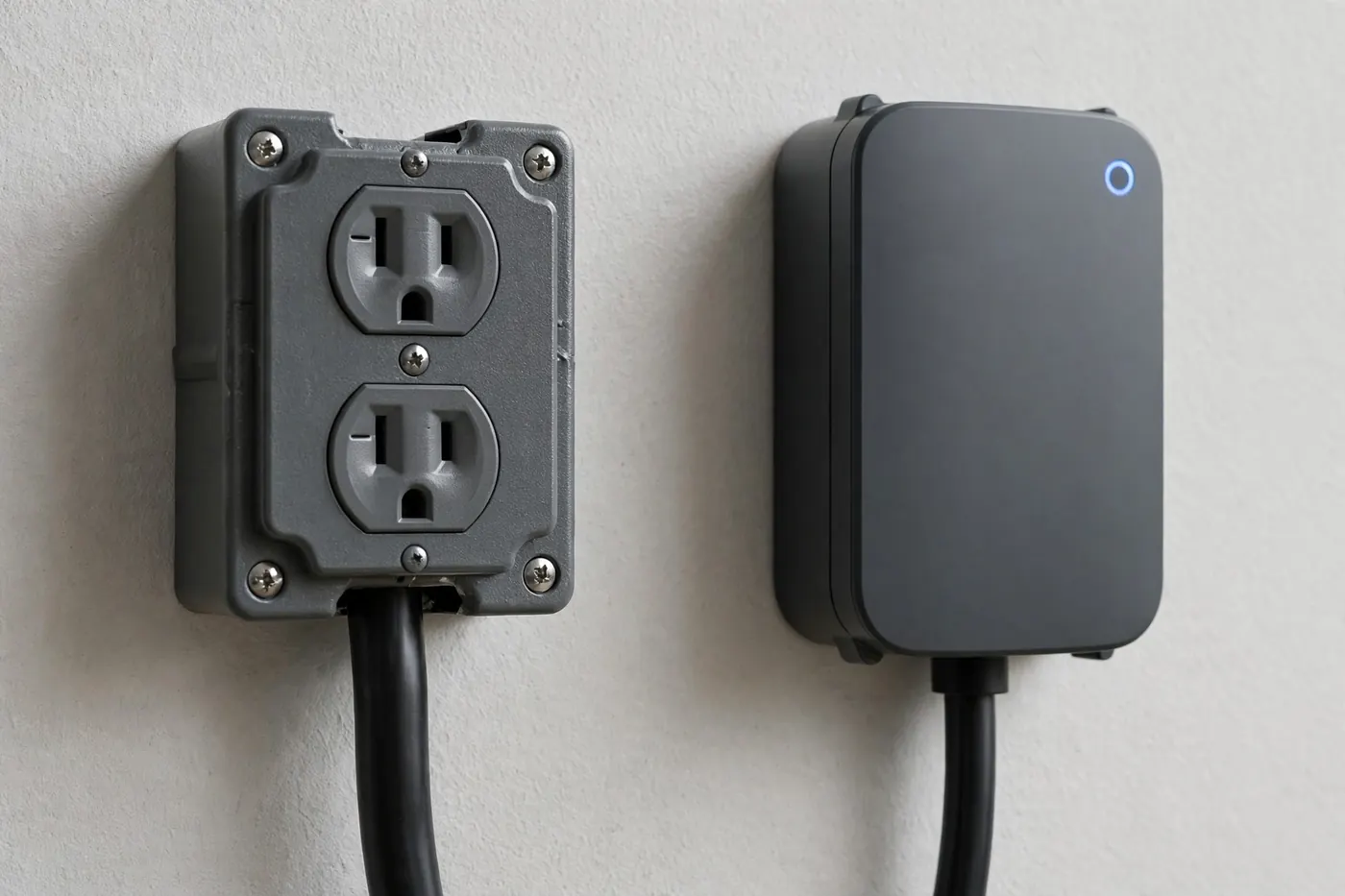
A plug-in installation adds a 240-volt circuit ending in an industrial-grade NEMA 14-50 outlet on the garage wall. The charger — either a portable cord or a wall unit with a short plug — connects to that outlet, and can be unplugged in seconds. The outlet itself is a general-purpose 240-volt receptacle of the same family used by electric ranges and RV hookups, which is part of its appeal: the infrastructure is not charger-specific.
A hardwired installation runs the circuit directly into the charger, where the conductors land on terminals inside the unit and the connection is enclosed and permanent. There is no plug, no receptacle, and no intermediate connection point between the panel and the charger. The unit is removed only by disconnecting wiring, which is electrician work rather than a yank of a plug.
Neither connection changes what the car experiences. The charger delivers AC power at the circuit's rate, the car converts it, and the battery fills. Everything below is about your life around the charger, not the car's.
Flexibility and Relocation

The plug-in route's headline advantage is flexibility. Moving? Unplug the charger and take it with you; the outlet stays as a feature of the garage. Rearranging the garage or swapping to a different charger model years later is equally simple. Renters in the rare situation where they fund an installation, and homeowners who expect to move within a few years, lean toward the outlet for this reason. The outlet also serves double duty in some garages — an RV, a welder, a second portable cord — though sharing should be occasional and deliberate, not a daily plug-swapping habit, since receptacles wear with repeated insertions.
Hardwired is the opposite trade: permanence in exchange for simplicity of the electrical path. For a homeowner settled in a house they expect to keep, with the charger mounted exactly where the car will park for years, the flexibility being given up may be worth nothing at all — and what is gained is covered next.
Charging Speed and Circuit Size
Here the two options genuinely diverge. A plug-in charger on a NEMA 14-50 outlet runs on a 50-amp circuit and delivers up to 40 amps continuously to the car. For the large majority of EVs and Wichita commutes, that pace fills the battery overnight with hours to spare, as the math in our Level 1 vs Level 2 comparison shows.
Hardwiring unlocks larger circuits. Chargers wired directly can be installed on 60-amp circuits and above, delivering proportionally more power to cars whose onboard chargers can accept it — typically large-battery trucks and SUVs. If your vehicle can use the higher rate and your panel supports the circuit, hardwired is the only route to it, because the 14-50 plug itself caps the plug-in option. The panel capacity guide explains how to know whether your service can feed a circuit of that size.
GFCI Protection and Outlet Quality

Two safety details deserve attention on the plug-in side. First, protection: current code requires GFCI protection for garage receptacles including 240-volt outlets, while many chargers also carry their own internal ground-fault protection. Coordinating the two so they do not nuisance-trip against each other is part of a proper installation design, and it is one reason the "just add an outlet" version of this project still belongs inside the permitted, professional process. Hardwired chargers rely on the unit's internal protection and avoid the double-protection puzzle entirely.
Second, outlet quality matters enormously. A 14-50 receptacle feeding an EV carries heavy current for hours, nightly, for years. Inexpensive builder-grade receptacles designed for a range that cycles are not built for that duty the way industrial-grade receptacles are, with their heavier contacts and better heat tolerance. If you choose the plug-in route, the receptacle specification is not the place to economize; heat at a worn or lightly built outlet is the classic failure mode of plug-in charging, and our maintenance guide includes the heat checks that catch it early.
Two-EV Futures and Changing Cars

Think one vehicle ahead. If a second EV is plausible, consider what each connection implies. A plug-in setup lets a single outlet serve two portable cords on alternating nights — workable, if inelegant. A hardwired plan more often becomes two dedicated circuits, or one charger with load-sharing capability between two units, which our panel capacity guide discusses in the context of household limits. Connector changes point the other way: if your next car may carry a different port, as our NACS vs J1772 guide explains, a plug-in charger is trivial to swap, while a hardwired unit swap is a service call. Neither consideration decides alone, but both belong in the framework.
A Decision Framework

Choose the plug-in route if you value portability, expect to move or rearrange within a few years, want the outlet's versatility, or know your charging needs fit comfortably within a 50-amp circuit — which covers most Wichita households. Choose hardwired if you want the highest charging rate your car can accept, prefer the cleanest possible electrical path with no receptacle to wear, are mounting the charger outdoors where a sealed connection is attractive, or are settling into a long-term home and garage layout.
Notice what is not in the framework: the car does not care. This is a homeowner's decision about flexibility versus permanence, made once, with both answers respectable. Installers see garages every day, and a good assessment will lay out how each option fits your specific panel location and parking arrangement before you commit.
A Quick Decision Checklist

Still torn? Answer three questions. Do you expect to move or rearrange the garage within a few years? If yes, the outlet's flexibility argues for plug-in. Do you want the highest charging speed your car accepts? If yes, hardwired on a 60-amp circuit is the only route there. Is your panel short on space or capacity? Either route needs the same circuit, but a hardwired unit with built-in load management sometimes fits where a plug-in setup cannot. Two or more answers pointing the same way usually settles it — and the assessment confirms the choice against your actual panel before anything is installed.
Frequently Asked Questions
Can I convert a hardwired charger to a plug-in setup later?
Converting in either direction means electrical work: adding a receptacle and cord arrangement where a direct connection was, or removing an outlet and landing the circuit in the unit. It is entirely possible during a charger replacement, and the time to plan for it is when the circuit is designed — tell your installer if you think you will want that flexibility later.
Why does the quality of a 14-50 outlet matter so much?
Because EV charging is a sustained, heavy draw, not an occasional one. An industrial-grade receptacle has heavier contacts that grip the plug firmly and dissipate heat through hours of continuous current, night after night. A lightly built receptacle can loosen and overheat under the same duty. The receptacle is a small part of the project with an outsized effect on its long-term reliability.
Does a plug-in charger need GFCI protection twice?
Garage receptacles require GFCI protection under current code, and most chargers include their own ground-fault protection internally. Having both is common, but they must be coordinated so normal operation does not cause nuisance trips that interrupt charging. This coordination is a normal part of installation design and one of the details an inspector expects to see handled correctly.
Which connection suits a charger mounted outdoors?
Both can be installed outdoors with properly rated equipment, but hardwired has practical advantages: the connection is sealed inside the unit, there is no receptacle exposed to weather, and there is no plug for anyone to disturb. Outdoor plug-in setups need a weatherproof outlet enclosure rated for use while the plug is inserted, which your installer will specify.
Can I take a plug-in charger with me when I move?
Yes — that is the plug-in route's signature advantage. Unplug the unit and it travels with you; the circuit and outlet remain as part of the house. Your new home will need its own circuit and outlet installed for the charger, but the equipment investment moves with you instead of starting over.
Making the Choice for Your Garage

There is no universal winner between a NEMA 14-50 plug-in installation and a hardwired one — there is only the better fit for your home, your car, and your plans. Weigh flexibility against maximum speed, consider the outlet quality and protection details, and think one car ahead. To explore either route, browse our services and locations, or read more on the blog. When you are ready to talk through your garage specifically, reach out via our contact page and we will connect you with a local professional.