How to Find Public Chargers in Wichita

The reliable way to find public charging is through the tools that track it live. Charging network apps and general EV charging maps aggregate stations across operators, showing location, connector type, charging speed, and often whether a charger is currently in use or reported out of service. Start there rather than with a general web search, because the data is fresher and the filters are built for drivers.
Filtering is where these tools earn their keep. Set the connector filter to your car's port — J1772 or NACS for Level 2 charging, and the appropriate fast-charging standard for DC stations; our NACS vs J1772 guide explains the difference. Filter by speed next: Level 2 public chargers suit stops measured in hours, like a workday or a long shopping trip, while DC fast chargers suit stops measured in minutes on a travel day. Finally, check the station's recent status and any access notes — some chargers sit in parking structures or lots with their own hours — before you drive across town to one.
A habit worth building: check the app while you are still parked at home or work, not after you arrive at a charger to find it occupied. Public charging rewards a small amount of planning, which is both its nature and, for many drivers, its main drawback.
Where Public Chargers Tend to Cluster
Without naming specific stations, the pattern in a city like Wichita is predictable, because chargers follow parked cars and electrical capacity. Expect to find them around downtown destinations and parking facilities, near hospitals and medical campuses where staff and visitors park for long stretches, on and around college campuses, along major retail corridors where drivers already stop, at hotels, and at highway-oriented stops on the interstates and Kellogg corridor where fast charging serves through-travelers.
That pattern tells you something useful: public charging is densest where destinations are, not where homes are. Residential neighborhoods — where Wichita drivers actually start and end their days — are the thinnest part of the map. Which is, of course, the gap a home charger fills.
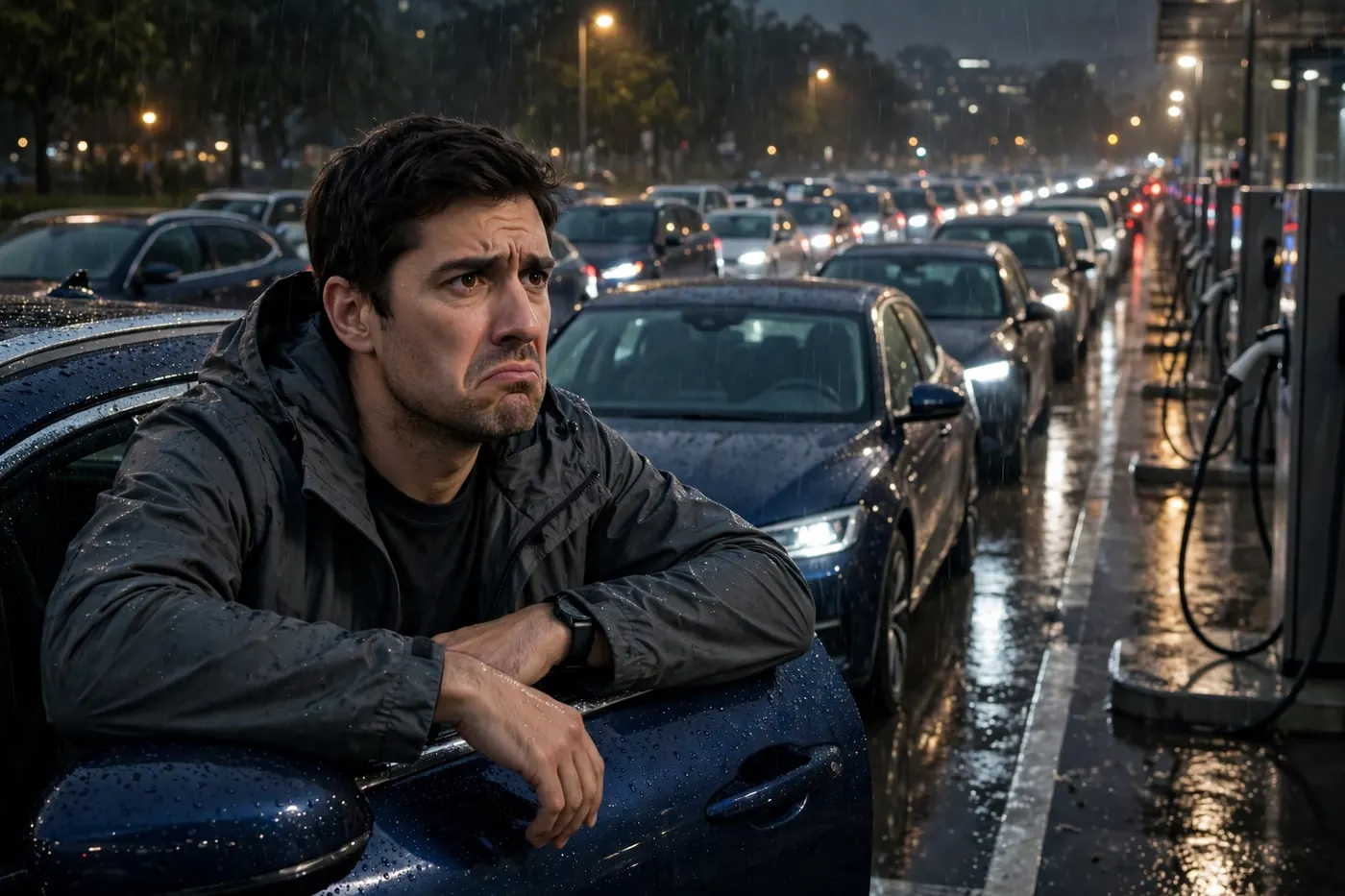
Public Charging: Strengths and Trade-Offs

Public charging's strengths are genuine. It requires nothing of your home, works for renters and travelers, and DC fast charging can return a large amount of range during a short stop on a road trip. For drivers whose housing situation rules out installation, a well-chosen public routine — a Level 2 charger near work, a fast charger for travel days — can make EV ownership work.
The trade-offs are equally genuine. Your charging happens on someone else's schedule and availability: a charger can be occupied, blocked, or out of service when you arrive. Sessions happen where the charger is, not where you live, so charging time is rarely your own time. Weather in Kansas adds its own tax, since a public session in January wind or August heat is a different experience from plugging in inside your own garage. And per-session pricing structures vary by network and charger type, so the ongoing expense of depending entirely on public charging is harder to predict than charging at home on your household's existing electric service. None of this makes public charging bad. It makes it a tool — excellent for travel and gaps, wearing as a daily system.
Home Charging: Strengths and Trade-Offs

A home charger inverts every one of those trade-offs. The car charges where it already parks, overnight, on a Level 2 installation sized to your panel and routine. You leave each morning with the range your day needs, sessions never compete with another driver, and the garage is sheltered in every season. For commuters crossing Wichita on Kellogg, I-135, or K-96, that overnight readiness is the entire ballgame, as the math in our Level 1 vs Level 2 comparison shows.
Home charging's trade-offs are front-loaded instead of ongoing. There is an installation project — a circuit, possibly panel work, a permit, an inspection — with the scope factors described in our guide to installation cost factors. It requires a home where you can install, which excludes some renters and some housing arrangements. And it does nothing for you three hundred miles from home, where public fast charging remains the tool. Most Wichita EV households end up using both: home charging as the system, public charging as the supplement. The question is which one carries the daily load.
A Practical Way to Decide
Add up a typical month. Count your public charging stops, the detours they required, the waits, and the mornings you started with less range than you wanted. Then compare that ongoing friction against a one-time installation project at home. Drivers with short, predictable routines and a charger near their workplace sometimes find the public routine perfectly sustainable, and if that is you, use the filters above and drive on with our blessing.
Drivers whose month shows a pattern of small annoyances — the occupied charger, the extra stop on a cold night, the weekend errand run reorganized around range — are describing exactly the problem a home charger solves. Businesses have the same decision at a larger scale, which our commercial EV charging station installation page addresses for workplaces and fleets.
Frequently Asked Questions
How do I filter a charging map for my connector type?
Open the app's filter settings and select your car's port: J1772 or NACS for Level 2 stations, and your car's DC fast-charging standard for fast chargers. Most apps also let you filter by network, speed, and availability. Setting the connector filter first prevents the most common frustration — arriving at a charger your car cannot plug into.
Can I rely on public charging if I rent my home?
Many renters do, especially when a charger sits near their workplace or along their regular routes. It works well with a predictable routine and a backup station in mind for the days your first choice is occupied. If your lease and landlord allow it, a home installation conversation is still worth having, but public charging is a workable system in the meantime.
What should I check before driving to a public charger?
Check the station's live status in its network app, confirm the connector matches your car, note any access restrictions such as parking structure hours, and glance at recent driver reports if the app shows them. A thirty-second check before you leave prevents most wasted trips, since availability changes faster than any static listing can track.
Do public chargers work in Wichita winter weather?
Public chargers operate year-round, and EVs charge in deep cold, though sessions can run slower while the battery warms and range itself is lower in winter. The bigger winter difference is personal: a public session means a trip out in the weather, while a home charger means plugging in inside your garage and going inside. Both work; they feel very different in January.
If I install a home charger, will I still use public charging?
Yes, on the days it is the right tool: road trips, unusually long days, and travel to other cities. Most home-charging households find public charging becomes occasional rather than routine — a supplement for journeys instead of a system for daily life. That shift, from depending on the map to glancing at it before a trip, is the change home installation actually buys.
From Searching to Plugging In at Home

"EV chargers near me" is a fine question for a road trip. For daily life in Wichita, the better answer is usually a charger where you already park. If you want to explore that option, look at our services, the locations we serve, and more guides on the blog. When you are ready to trade the map search for a garage installation, reach out through our contact page and we will connect you with a local professional.