What a NEMA 14-50 Outlet Is — and Is Not
The designation describes the receptacle pattern: 14-50 means a 125/250V outlet rated for 50 amps, with two hot conductors, a neutral, and a ground. For EV charging, the circuit behind it is what counts: a dedicated 50-amp breaker, wire sized for that breaker and the run length, and no other loads sharing the circuit. Your plug-in charger draws up to 40 amps continuously, following the rule that continuous loads use 80 percent of circuit capacity.
It is not the same as plugging into whatever 240V outlet already exists in the house. A laundry-room dryer outlet is typically a different pattern, on a 30-amp circuit, in the wrong room, and shared with an appliance you still need. It is also not a reason to use adapters, splitters, or extension cords for daily charging — each adds connection points that heat and wear under continuous load. A purpose-installed EV outlet replaces all of that improvisation with one correct circuit in the right place: your garage or parking area.
If you are still deciding between an outlet and a fixed unit, our guide to NEMA 14-50 vs. hardwired EV chargers compares the two paths directly, and our Level 2 EV charger installation page covers the charging speeds both deliver.
The Wrong Outlet Under a Continuous Load

An EV is the hardest-working load most garages will ever see. A dryer runs in cycles for an hour. An EV charger pulls near its full rated current for four, six, even ten hours straight, then does it again the next night. Standard residential-grade receptacles — the inexpensive kind stocked for occasional appliance use — were not designed for that duty cycle or for a heavy plug being inserted and removed daily for years.
Under continuous load, weak contact pressure inside a standard outlet creates resistance, resistance creates heat, and heat degrades the receptacle and plug over time. Warning signs include a plug that feels loose or sags, discoloration around the slots, warmth on the outlet face after charging, or a breaker that trips mid-session. Wichita summers add to the stress, since a garage that sits at 100 degrees starts every charging session already hot. The outlet is a small part of the project budget and a large part of its safety — it is the wrong place to cut corners.
An Industrial-Grade, EV-Rated Receptacle on Its Own Circuit

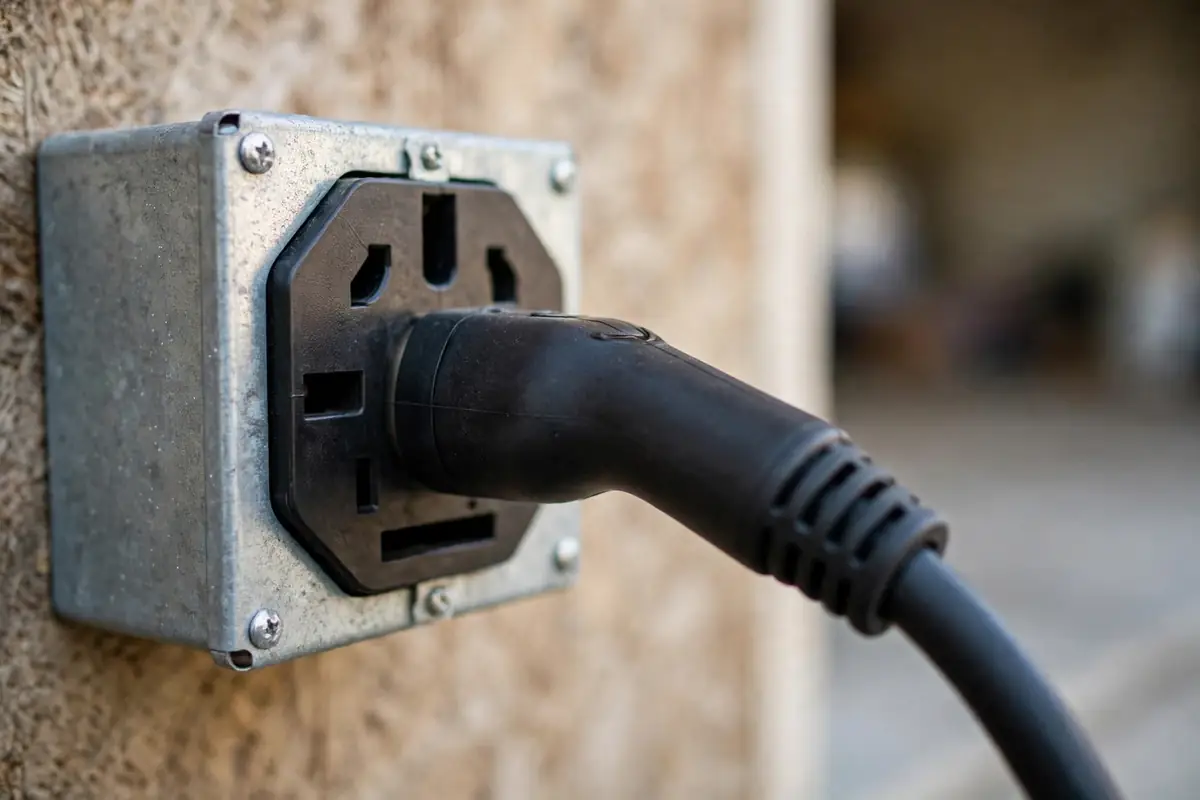
The solution is a heavy-duty, industrial-grade NEMA 14-50 receptacle built for EV service: stronger contacts that grip the plug firmly, terminals designed for properly torqued connections with larger wire, and materials rated to handle sustained heat. Installed on a dedicated 50-amp circuit with the correct breaker protection and inspected through MABCD, it is built for exactly the load your car places on it, night after night.
Your electrician will also confirm the details that separate a durable install from a marginal one: wire size matched to breaker and distance, connections torqued to specification, the receptacle mounted securely so daily plugging does not loosen it, and the breaker labeled clearly at the panel. If your panel lacks capacity or spaces, options include load management or an electrical panel upgrade for your EV charger — the assessment will identify which applies. For a broader view of the home project around the outlet, see residential EV charger installation.
GFCI Breaker Requirements

Garage receptacles, including 240V EV outlets, require ground-fault protection under current electrical code. For a NEMA 14-50 EV circuit, that protection typically comes from a GFCI breaker at the panel rather than a GFCI receptacle. The breaker monitors for ground faults across the whole circuit and shuts power off if it detects an imbalance that could indicate a shock hazard — an important safeguard in a garage where moisture, concrete floors, and outdoor exposure are part of the environment.
One practical note: some plug-in chargers and mobile cords include their own ground-fault protection, and in rare combinations two layers of protection can cause nuisance tripping. An electrician familiar with EV work will select a breaker and charger combination known to work together reliably, and will test the full setup with your vehicle before finishing. If you ever experience repeated tripping on a new install, that is a reason to call for a check — through EV charger repair if the charger itself is at fault — rather than to work around it. Never replace a GFCI breaker with a standard breaker to stop tripping; the protection is required, and tripping is information, not an inconvenience to bypass.
Permitting ties this together. New 240V circuits in the Wichita area are permitted through MABCD, the Metropolitan Area Building and Construction Department, and the inspection verifies breaker type, wire sizing, and receptacle installation. Our EV charger permit guide for Wichita explains the steps.
Placement: Where the Outlet Goes and How High
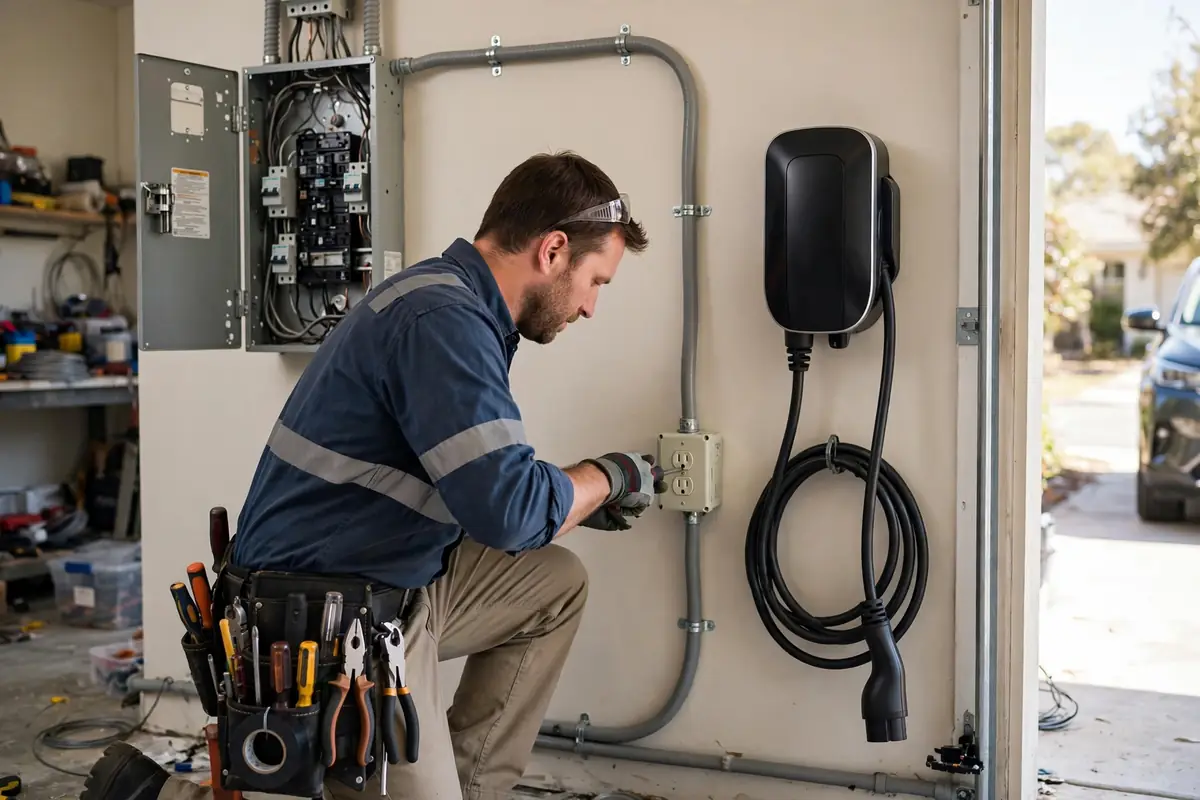
Placement follows your parking routine. The outlet should sit on the wall nearest your vehicle's charge port in its normal position, close enough that the charger cable reaches with slack but not so close that the plug and charger body crowd the car's door swing. Because the plug-in charger or mobile cord hangs from the outlet, leave clear wall space below and beside it for the unit and its coiled cable, plus a hook or holster to keep the vehicle connector off the floor.
Mounting height is typically around 36 to 48 inches from the garage floor to the center of the receptacle — high enough to stay clear of floor moisture, snow melt, and casual bumps, low enough to plug in comfortably and let the charger hang without straining its cord. Your electrician will confirm the height against your charger's cord exit and your wall layout; the FAQ below covers the reasoning in more detail.
Outdoor placements need a weather-rated enclosure with an in-use cover, so the connection stays protected while plugged in during rain or snow. Driveway and carport installs across Wichita also need protected wiring runs and attention to sprinkler spray and winter ice. You can see the communities we serve on our locations page.
Plug-In Chargers and Mobile Cords: Daily Use

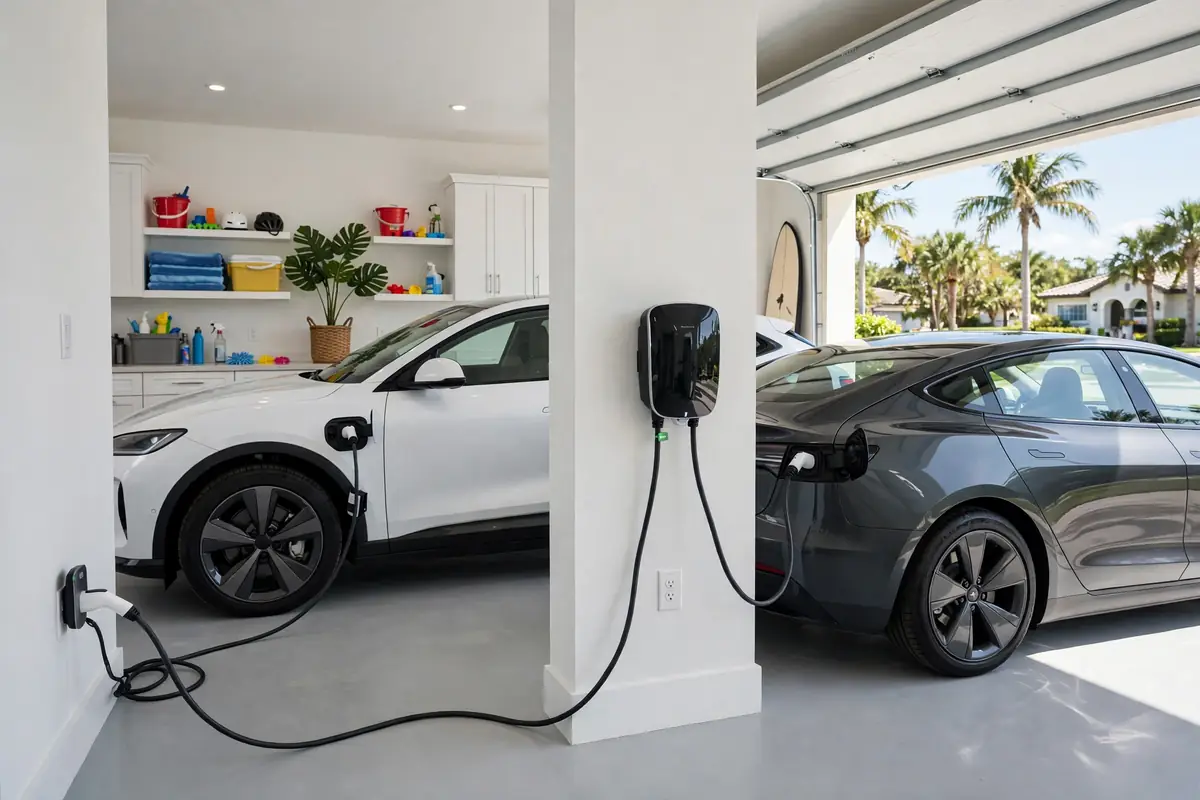
Two kinds of equipment plug into a NEMA 14-50 outlet. A dedicated plug-in wall charger mounts beside the outlet, stays plugged in, and offers features like scheduling, app monitoring, and a holstered cable — the closest experience to a hardwired unit, with the option to unplug and move it later. A mobile cord — the portable charger supplied with many EVs — plugs in when needed and otherwise lives in the car or on a shelf. It delivers solid Level 2 speed on a 14-50 circuit, up to its own amperage limit, which is lower than a full-size wall charger on some models.
Daily habits extend the life of either setup. Keep the wall charger's plug fully seated and leave it in place rather than unplugging nightly — the outlet is happiest when the plug stays put and only the vehicle connector moves. With a mobile cord, avoid letting the control box dangle from the outlet by its cord; support it on a hook or shelf so its weight does not pull on the plug. Periodically check that the plug still seats firmly and shows no discoloration. If an aging charger needs attention, EV charger replacement covers swapping plug-in units, which is straightforward on an existing outlet circuit.
Tesla owners can also use a 14-50 outlet with the mobile connector, though many choose a hardwired wall unit for daily use — our Tesla charger installation page explains that comparison. Households adding charging beyond a single garage, such as a shop or small business, should review commercial EV charging station installation for the different requirements involved.
NEMA 14-50 vs. Hardwired: An Honest Comparison

An outlet install tops out at 40 amps of charging on its 50-amp circuit, or roughly 37 miles per hour. A hardwired charger on a 60-amp circuit reaches 48 amps and roughly 44 miles per hour. For most Wichita commutes — 40 to 70 miles a day — both refill the car well within an overnight window, so the speed gap rarely decides the question. Portability and permanence do.
Choose the outlet when you may move within a few years, want to take your charger with you, prefer the option to swap charger brands without electrical work, or are equipping a home where a future buyer may bring any brand of EV. Choose hardwired when you want maximum speed, a power-sharing pair for two EVs, or the fewest possible connection points for a decade of daily use. Neither is a compromise when installed correctly — they are two good answers to different plans. Our services page summarizes both, along with the factors in our guide to installation cost factors.
Frequently Asked Questions
Can I just use my existing dryer outlet for my EV?
Usually not as a practical daily solution. Most dryer outlets are a different receptacle pattern on a 30-amp circuit, located in the laundry room rather than the garage, and already serving your dryer. Sharing it means unplugging the dryer to charge, running a cord through the house, and charging at a lower rate — while adapters and splitters add connection points that are not suited to continuous EV load.
A dedicated NEMA 14-50 circuit in the garage solves the location, capacity, and sharing problems at once. If your dryer outlet happens to be in the garage, your electrician can evaluate it during an assessment, but in most Wichita homes a new dedicated circuit is the right answer.
Why does an EV outlet need to be industrial grade?
Because EV charging is a continuous, high-current load sustained for hours, repeated daily for years. Industrial-grade receptacles use stronger contacts, better heat tolerance, and terminals that hold torque on larger wire, so the plug stays tight and cool under that duty. Standard residential-grade outlets are built for intermittent appliance use and can loosen and overheat under EV cycling.
The price difference between grades is small relative to the project, while the outlet is the single most-stressed connection in a plug-in setup. Specifying EV-rated, industrial-grade hardware is one of the clearest quality markers of a careful installation.
Does a NEMA 14-50 outlet need a GFCI breaker?
Yes. Current code requires ground-fault protection for garage receptacles, and for a 240V NEMA 14-50 EV circuit that protection is provided by a GFCI breaker at the panel. It protects the entire circuit and is verified during the MABCD inspection of your permitted installation.
Some chargers include their own ground-fault protection, and your electrician will choose a compatible breaker-and-charger combination to avoid nuisance tripping. If tripping does occur repeatedly, have it checked — do not swap the GFCI breaker for a standard one, since the protection is a code requirement and a genuine safety feature in a garage environment.
How high should a garage EV outlet be mounted?
A common range is about 36 to 48 inches from the floor to the center of the receptacle. That height keeps the outlet clear of floor moisture, snow melt, and standing water, while keeping plugging comfortable and letting a wall charger's cord hang without strain. It also places the charger body at a convenient height for its status lights and cable holster.
The exact height is set during installation based on your charger's design, cord exit direction, and wall layout. If you have a specific need — a workbench below, storage above, or accessibility considerations — tell the electrician during the site visit so the placement is planned around it.
How do plug-in and hardwired chargers compare on safety when both are installed correctly?
When both are installed correctly — correct breaker and wire, quality hardware, permitted and inspected — both are safe, code-compliant ways to charge. The differences are structural: hardwiring removes the plug-and-receptacle connection entirely and allows higher amperage, while a plug-in setup includes one additional connection point that must be high-quality and periodically checked for firm seating and discoloration.
That is why outlet grade matters so much for plug-in charging, and why the comparison in our hardwired vs. plug-in guide focuses on hardware quality and habits rather than declaring one approach unsafe. Choose based on speed, portability, and permanence, and let correct installation handle safety in either case.
A Flexible Outlet, Installed for Years of Daily Charging

A NEMA 14-50 outlet gives Wichita EV owners a practical middle path: full Level 2 overnight charging, a charger you can take with you, and a circuit that welcomes whatever plug-in unit you choose next. Its reliability comes from the unglamorous details — an industrial-grade receptacle, a GFCI breaker, correctly sized wire, and a permitted inspection through MABCD.
Wichita EV Charger connects you with an independent local electrician to assess your panel, plan placement, and complete the installation. Head to our contact page to schedule a visit, or review the full range of home charging options under residential installation before you decide.