What a Load Calculation Actually Is

Your home's electrical service has a rated capacity — commonly 100 amps or 200 amps — the maximum the utility feed and main breaker are built to deliver. A load calculation estimates the demand the home places against that rating, using NEC rules rather than guesswork. It accounts for square footage at a standard general-use rate, the required small-appliance and laundry circuits, and each large fixed appliance: range, dryer, water heater, air conditioning, heating equipment, and so on.
The crucial insight is that the calculation does not assume everything runs at full power simultaneously. It applies demand factors — structured reductions the code allows because real homes diversify their loads. The oven cycles, the dryer runs an hour, the air conditioner peaks on August afternoons while other loads idle. The result is a considered engineering figure rather than the sum of every nameplate in the house.
An EV charger enters this math as a continuous load: it draws its full rated current for hours without cycling. The code treats continuous loads conservatively, sizing the circuit above the charger's draw, and the charger's full demand counts against the service with no diversity reduction. That is precisely why a charger can be the load that tips a borderline panel over its limit even though the house has "worked fine for years."
100-Amp vs 200-Amp Service in Plain English
Many older Wichita homes, including plenty of mid-century ranch houses, were built with 100-amp service — generous capacity for the era's loads. A modern 100-amp home may now carry central air, an electric range, an electric dryer, and a water heater, a stack the original service was never asked to hold.
A 200-amp service, standard in newer construction, roughly doubles the headroom. Most 200-amp homes absorb a charger circuit within their calculated capacity, though heavily electrified homes — electric heat, a workshop, a hot tub, a second EV — can still reach the limit.
The practical point: the service size on your main breaker starts the conversation, but only the calculation finishes it. Two 100-amp homes can get different answers depending on whether their big loads are gas or electric. A home with a gas range, gas dryer, and gas water heater may have ample room on 100 amps; its all-electric twin may not.
Demand Factors: Why the Math Is Not Simple Addition
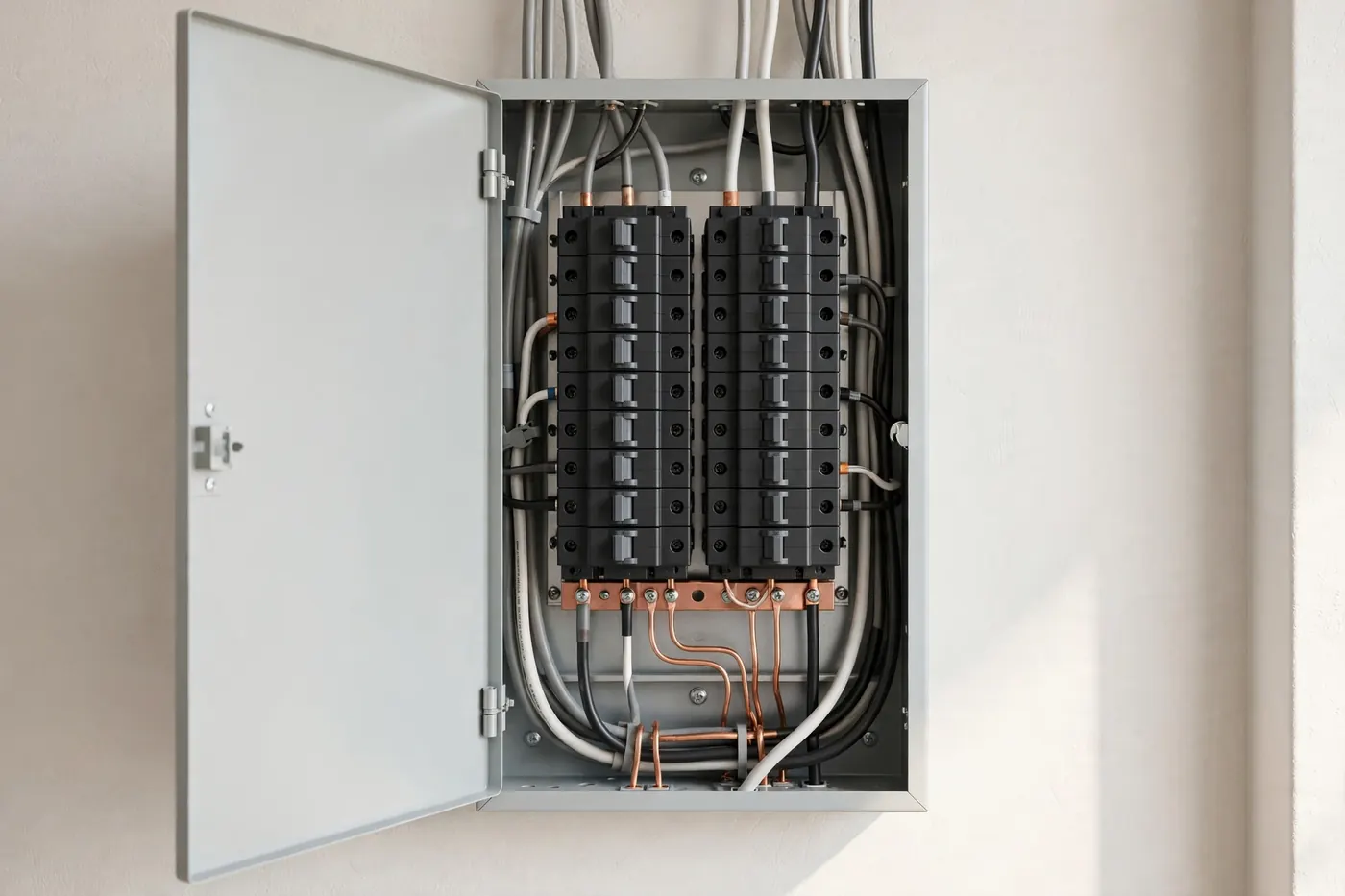
Homeowners often try the calculation themselves by adding breaker ratings down the panel — and conclude the panel is overloaded already, since breakers typically sum to far more than the main breaker's rating. That is normal. Breakers protect individual circuits; they are not a budget that must sum to the service size. The load calculation exists precisely because addition is the wrong tool.
Demand factors formalize how real usage works. The first portion of general lighting and receptacle load counts in full, with additional portions counted at a reduced rate. Certain appliances count at nameplate, heating and cooling count at whichever is larger rather than both, since they do not run together, and multiple similar appliances may earn a collective reduction. An electrician performing the calculation works through the NEC's standard method (or the optional method for existing homes) and arrives at a single demand figure to compare against the service rating. The space between that figure and the rating is your true headroom for a charger.
Worked Example: A Fictional Wichita Ranch Home

Consider a fictional 1,600-square-foot Wichita ranch home with 100-amp service — a composite example, not a real house. Its large loads are a central air conditioner, an electric range, an electric dryer, and an electric water heater. A load calculation for such a home, after demand factors, might land its existing demand in the mid-80s in amps against the 100-amp service — leaving roughly 15 amps of headroom.
A typical Level 2 charger on a 50-amp circuit draws 40 amps continuously — far beyond 15 amps of headroom. The calculation therefore says this panel, as it stands, cannot simply accept the charger. Note what the example shows: the house functions perfectly today, the panel has physical breaker spaces open, and yet the charger does not fit by the numbers. This is the most common surprise in EV projects, and it is a calculation result, not a sales pitch.
Now change one fact: the same home with 200-amp service would show the same mid-80s demand against twice the capacity, leaving well over 100 amps of headroom. The charger fits easily, and so would a second one later. Service size, more than any single appliance, decides how simple an EV project is.
Load Management: Another Path to Yes

When the calculation comes up short, a full service upgrade is not the only answer. Load management devices monitor the home's total draw and automatically pause or throttle the charger when other large loads run, then restore full charging when the house quiets down. Because the charger can never push the service past its limit under this arrangement, the code recognizes it as a legitimate way to add a charger to a constrained panel.
Overnight, when the charger does most of its work, the house's other loads are asleep anyway, so the charger runs at full pace nearly all the time. Load management also suits two-EV homes sharing one service, a scenario discussed in our look at when to upgrade your charger. Whether it fits your home depends on the calculation and your appliance mix.
Subpanels and Service Upgrades

Two other tools solve different problems. A subpanel adds breaker space and organizes circuits — useful when the main panel is physically full or a detached garage needs its own distribution point — but it does not add capacity to the service itself. It answers "no room for another breaker," not "no headroom in the calculation."
A service upgrade replaces the service equipment to raise the rating itself, typically from 100 amps to 200 amps. It is the most involved option and the most future-proof: it creates headroom for the charger, a second EV, and whatever electrification comes next. The service page for an electrical panel upgrade for an EV charger describes what that project includes. Which tool fits — management, subpanel, upgrade, or simply proceeding because the calculation already passes — is an assessment question, and it is also one of the main cost drivers explained in our guide to installation cost factors.
Frequently Asked Questions
How can I tell what size electrical service my home has?
Look at the main breaker in your panel; its rating, commonly 100 or 200 amps, is printed on the breaker handle or its label. That number is your service size and the starting point for any capacity conversation. It is not, by itself, the answer — the load calculation compares your home's modeled demand against that service rating.
Does an empty breaker slot mean I have capacity for a charger?
No. An empty slot means there is physical space for a breaker; capacity is a calculation, not a space count. A panel can have several open slots and still be at its calculated demand limit, and a panel with no open slots can sometimes accept a charger through a subpanel or tandem arrangement if the calculation allows. The two questions are separate.
Can two EV chargers share one panel?
Often, yes. On a 200-amp service, two chargers frequently fit within the calculated capacity. On tighter services, load management equipment can coordinate both chargers and the home's other loads so the total never exceeds the service rating, with the cars sharing available power overnight. The load calculation decides which arrangement your home needs.
What is the difference between a subpanel and a service upgrade?
A subpanel adds breaker spaces fed from the existing service; the home's total capacity stays the same. A service upgrade raises the capacity itself by replacing the service equipment, typically moving a home from 100-amp to 200-amp service. One solves a space problem, the other solves a capacity problem, and some projects need both.
Will a load calculation change if I add a hot tub or workshop later?
Yes. The calculation models the home as it exists, so adding a large load later — a hot tub, a workshop with electric heat, a second charger — changes the demand side of the equation. If you know such a project is coming, mention it during the charger assessment so the design can anticipate it rather than be revisited.
The Bottom Line on Capacity

Panel capacity is not a yes-or-no glance at a breaker box; it is a calculation with defined rules, and its outcome determines the shape of your project. Homes with headroom proceed directly to a Level 2 charger installation. Homes without it still have real options — load management, a subpanel for space, or a service upgrade for lasting headroom. Browse our services and locations, or read more on the blog. When you want your panel evaluated, reach out through our contact page and we will connect you with a local professional to run the numbers.