What Level 2 Charging Actually Means
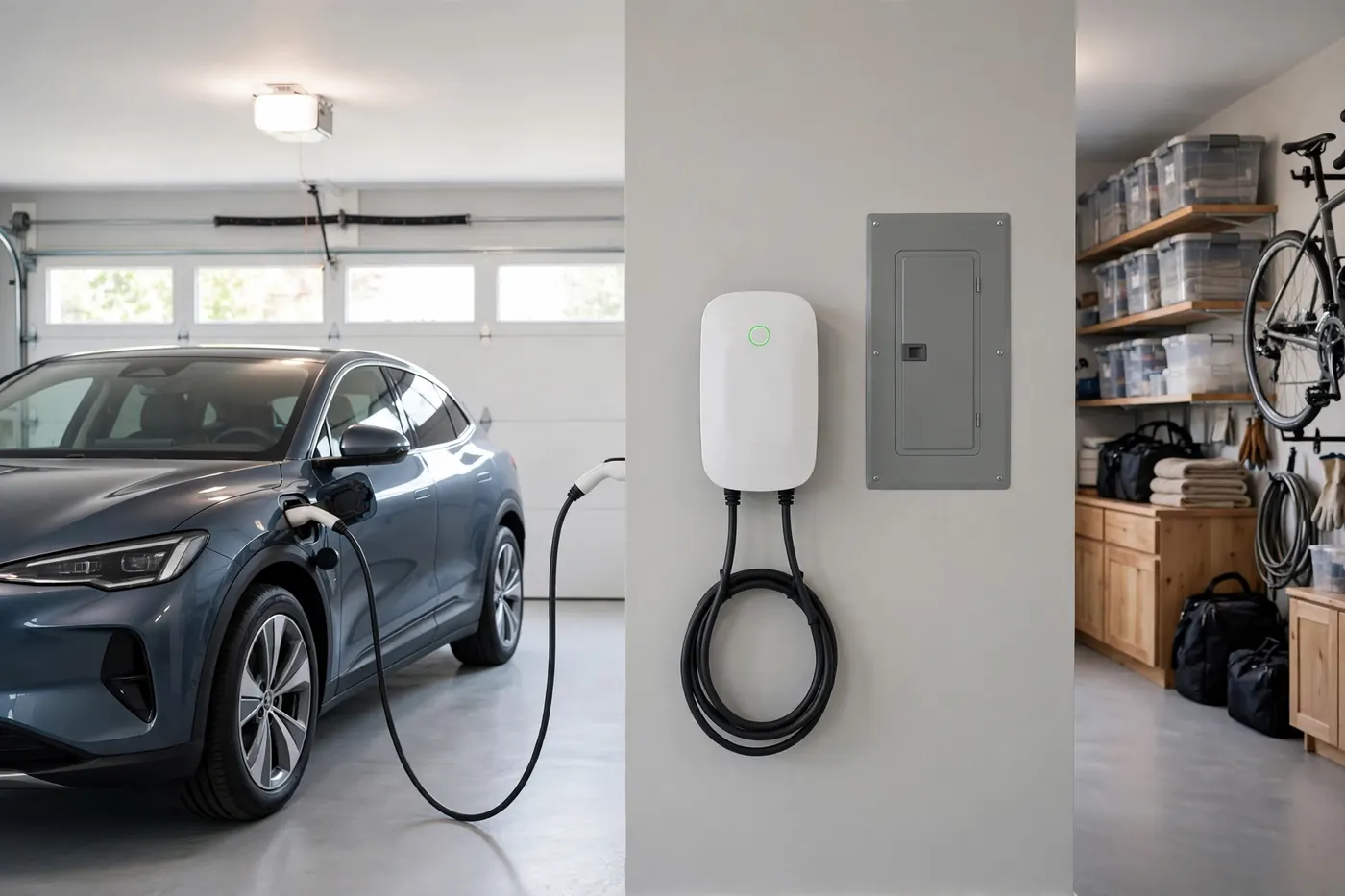
Level 2 simply means charging from a 240V circuit, the same voltage class as an electric dryer or range, but on a dedicated circuit sized for the charger. The charger itself — technically the EVSE, the box on your wall — safely delivers AC power to the car, and the car's onboard charger converts it to DC for the battery. That onboard charger sets a ceiling on speed, which is why two different EVs on the same wall unit can charge at different rates.
Speed scales with amperage. A charger delivering 32 amps adds roughly 25 to 30 miles of range per hour. At 40 amps, expect roughly 30 to 37 miles per hour. At 48 amps, vehicles that can accept it add roughly 44 miles per hour. Plug-in hybrids, with smaller batteries and often smaller onboard chargers, fill in an hour or two even on modest Level 2 circuits.
For context on the daily routine difference, read our guide to Level 1 vs. Level 2 charging. If you are planning a full home project rather than just the circuit, our residential EV charger installation page covers the complete process.
- 120V outlet
- 3-5 miles per hour
- no new circuit
- 240V circuit
- 25-45 miles per hour
- dedicated breaker
Breaker Sizes: 40, 50, and 60 Amps Explained

EV charging is a continuous load, so code requires the circuit to be sized above the charger's steady draw: a charger may draw 80 percent of its breaker rating continuously. That single rule explains the standard pairings Wichita homeowners will hear about.
40-Amp Circuit, 32-Amp Charging

This is the entry Level 2 setup, and for many drivers it is all they ever need. At roughly 30 miles per hour, an eight-hour overnight session can add up to 240 miles — well beyond a typical day. It is also the gentlest option for panels with limited capacity, including many 100-amp homes when paired with load management.
50-Amp Circuit, 40-Amp Charging

The middle option adds roughly 37 miles per hour and is a common match for plug-in chargers on a NEMA 14-50 outlet installation, since the 14-50 receptacle is a 50-amp device. It suits drivers with longer commutes or larger-battery vehicles who want a comfortable margin without stepping up to the largest circuit.
60-Amp Circuit, 48-Amp Charging
The largest common residential setup delivers roughly 44 miles per hour on vehicles that can accept 48 amps. It requires hardwiring — plug-in receptacles top out at 50 amps — and it needs the most panel capacity. It makes sense for high-mileage drivers, households planning a second EV with power sharing, and owners who want the shortest possible turnaround between arriving home late and leaving early.
Wire size follows breaker size and run length. Longer runs, such as from a basement panel to a detached garage, may need larger wire to limit voltage drop. Your electrician sizes this during the assessment — it is not a place for guesswork. Our guide to EV charger installation cost factors explains how circuit size and distance shape a project's scope.
A Commute That Outruns Your Outlet

Consider a common Wichita pattern. You live on the west side near Goddard or Maize and work near the east side, or you live in Derby and commute downtown. Your round trip on Kellogg and US-54, plus school runs and errands, totals 50 to 70 miles. On a Level 1 cord at 4 miles per hour, replacing 60 miles takes 15 hours — longer than the car is parked at home. You start each day slightly behind, fall further behind after a busy weekend, and end up at a public charger to catch up.
Winter makes it worse. Cold batteries charge more slowly, cabin heating draws more energy, and range per kilowatt-hour drops, so the same commute consumes more of the battery while your outlet replaces it at the same slow rate. Add a second driver sharing the car, or a plug-in hybrid that never quite refills and burns gasoline you bought the car to avoid, and the outlet setup quietly fails at its one job.
Overnight Charging Matched to Your Miles

Level 2 solves the math with margin to spare. Take that same 60-mile day. On a 32-amp Level 2 charger at about 30 miles per hour, you replace it in roughly two hours. On a 48-amp setup, in under an hour and a half. Plug in at 9 p.m. and the car is done before midnight, then simply stays ready until morning. Even a 100-mile day — a round trip to Newton plus errands — refills in about three to four hours on the smaller circuit.
That margin changes behavior. You stop watching the battery percentage, stop rationing trips, and stop visiting public chargers for routine driving. Smart scheduling, covered below, lets the charger start automatically at a set overnight hour, so you do not even need to think about timing. The car is simply full when you leave, every day, including the coldest weeks of January.
If you already have a charger that underperforms or has failed, EV charger repair and EV charger replacement are separate paths from a new installation — worth a look before assuming you need to start over.
Hardwired vs. Plug-In Level 2 Chargers

Both configurations deliver Level 2 charging. The difference is how the charger connects to the circuit, and it affects maximum speed, permanence, and flexibility.
A hardwired charger is wired directly into the circuit with no plug. Hardwiring is required for 48-amp charging on a 60-amp circuit, removes the receptacle as a wear point, and gives the cleanest permanent installation. It is the natural choice when you know your parking setup is stable for years.
A plug-in charger connects to a NEMA 14-50 outlet on a 50-amp circuit and delivers up to 40 amps. It offers flexibility: you can unplug and take the charger if you move, or swap units without electrical work. The outlet must be EV-rated and installed correctly for continuous load — our comparison of NEMA 14-50 vs. hardwired EV chargers and the Tesla charger installation page, which discusses hardwired wall units, both go deeper. Tesla owners in particular often compare a hardwired wall unit against the mobile connector on an outlet, and the same principles apply across brands.
Neither choice is universally right. Renters who have permission for an outlet install, households expecting to move, and drivers who want a travel-ready plug-in unit lean plug-in. Owners settling in for the long term, high-mileage drivers, and two-EV power-sharing setups lean hardwired. Your electrician can price the electrical scope for both during one visit.
Load Management When Your Panel Is Tight
A Level 2 circuit is a large load, and not every Wichita panel has 60 spare amps. Older homes in Riverside, Delano, and College Hill often run 100-amp service with air conditioning, an electric range, and a dryer already competing on summer evenings. That does not disqualify the home from Level 2 charging.
Load management solves it by watching total household demand and adjusting the charger in real time. When the house is quiet overnight, the car charges at full configured speed. When the air conditioner, oven, and dryer run together, the charger slows or pauses so the total stays within service limits, then speeds back up. Because most charging happens overnight while the house sleeps, drivers rarely notice any difference in the morning.
Alternatives include choosing a smaller circuit — a 40-amp circuit with management covers most commutes — adding a subpanel where spaces are the only issue, or upgrading the panel itself. An electrical panel upgrade for your EV charger makes sense when the service is undersized for several future needs, not just the car. The load calculation during your assessment determines which option fits, based on your appliances and service size rather than assumptions.
Smart Scheduling and Everyday Use
Most modern Level 2 chargers include scheduling through an app or the vehicle itself. You set a start hour, plug in when you get home, and charging happens automatically overnight — useful for keeping charging in low-demand hours and coordinating two vehicles that share power.
App monitoring also shows session energy, which helps households track consumption month to month. If your garage Wi-Fi signal is weak, mention it before installation — smart features depend on that connection, even though basic charging does not.
For businesses, the scheduling and access picture changes with multiple drivers and public-facing use. See commercial EV charging station installation for how those projects differ from a home Level 2 install.
Permits and Installation Day in Wichita

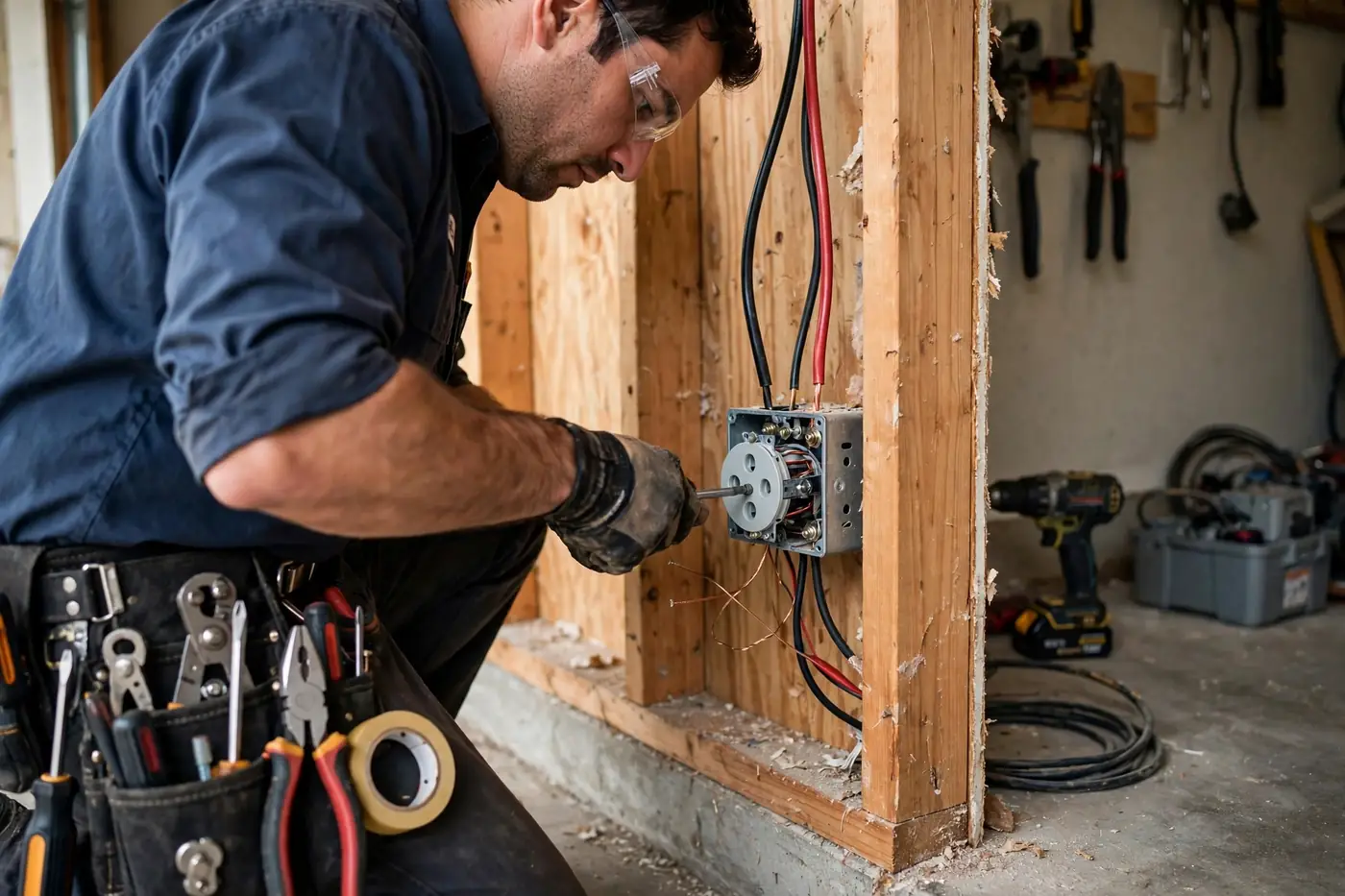
A new Level 2 circuit in the Wichita area needs a permit and inspection through MABCD, the Metropolitan Area Building and Construction Department. Your electrician pulls the permit, runs the circuit with correctly sized wire and breaker protection, mounts and commissions the charger, labels the breaker, and tests charging with your vehicle. Our EV charger permit guide for Wichita walks through the permit sequence step by step.
A typical straightforward job — panel near the garage, capacity available — takes a few hours. Panel work, long runs, or a detached garage extend the timeline. Review all options on the services page and the communities we serve on locations.
Frequently Asked Questions
How fast is Level 2 charging compared with Level 1?
Level 1 from a standard 120V outlet adds roughly 3 to 5 miles of range per hour. Level 2 on a 240V circuit adds roughly 25 to 45 miles per hour depending on amperage — about eight to ten times faster. In practical terms, a 60-mile day of driving takes around 15 hours to replace on Level 1 and about two hours on a typical Level 2 setup.
That gap is why Level 1 works only for short, predictable commutes, while Level 2 covers long commutes, winter range loss, and busy weekends without public charging stops. Our Level 1 vs. Level 2 guide includes more daily-mileage examples.
What size breaker does a Level 2 charger need?
The common pairings are a 40-amp breaker for 32-amp charging, a 50-amp breaker for 40-amp charging, and a 60-amp breaker for 48-amp charging. The breaker is larger than the continuous draw because EV charging runs for hours, and code limits continuous load to 80 percent of the circuit rating.
The right size for your home depends on your vehicle's onboard charger, your daily mileage, and your panel's available capacity. Many Wichita drivers are fully covered by the 40- or 50-amp option. Your electrician confirms the fit with a load calculation during the assessment.
Can two EVs share one Level 2 circuit?
Yes, with power-sharing chargers. Two units on one appropriately sized circuit communicate and split the available current: each car gets half while both charge, and one speeds up as the other finishes or tapers. Overnight, that is usually more than enough for two typical commutes.
Sharing works well when both cars are parked for eight or more hours. Households with two long commutes and short overnight windows may prefer two separate circuits where panel capacity allows. Mention a second EV during the first site visit so conduit, circuit size, and placement anticipate it.
Should I choose a hardwired or plug-in Level 2 charger?
Choose hardwired if you want the fastest 48-amp charging, a permanent installation with no receptacle wear point, or a power-sharing pair. Choose plug-in if you value portability, expect to move, or want to swap chargers later without electrical work — plug-in units use a NEMA 14-50 outlet on a 50-amp circuit and deliver up to 40 amps.
Both are sound when installed correctly. The deciding factors are usually permanence, top speed, and whether your panel favors a 50-amp or 60-amp circuit. Our hardwired vs. plug-in comparison lays out the tradeoffs in full.
Is Level 1 charging enough for a plug-in hybrid?
Often, yes. Plug-in hybrids carry small batteries — typically enough for 25 to 50 miles of electric range — and even at Level 1 speed, an overnight session of ten hours usually refills them. If your hybrid is plugged in every night and your daily driving is within its electric range, Level 1 can be a sensible, no-installation starting point.
Level 2 becomes worthwhile for hybrids when you drive beyond the electric range mid-day and want a quick refill between trips, when two vehicles share one outlet, or when you expect a full EV next and want the circuit ready. A Level 2 refill for a hybrid typically takes one to two hours, turning an afternoon errand run back into electric driving instead of gasoline.
Level 2 Charging That Keeps Up With Wichita Driving

Your commute does not shrink in winter, and your schedule does not pause for a slow outlet. A properly sized Level 2 installation makes charging disappear into the background: plug in at night, leave full in the morning, every day on Kellogg, US-54, and I-135.
Wichita EV Charger connects you with an independent local electrician for the load calculation, MABCD permit, installation, and inspection. Start from our contact page to schedule an assessment, or compare related options including residential installation and outlet-based charging before you decide.