The Long Run: Clearwater's Signature Install Challenge

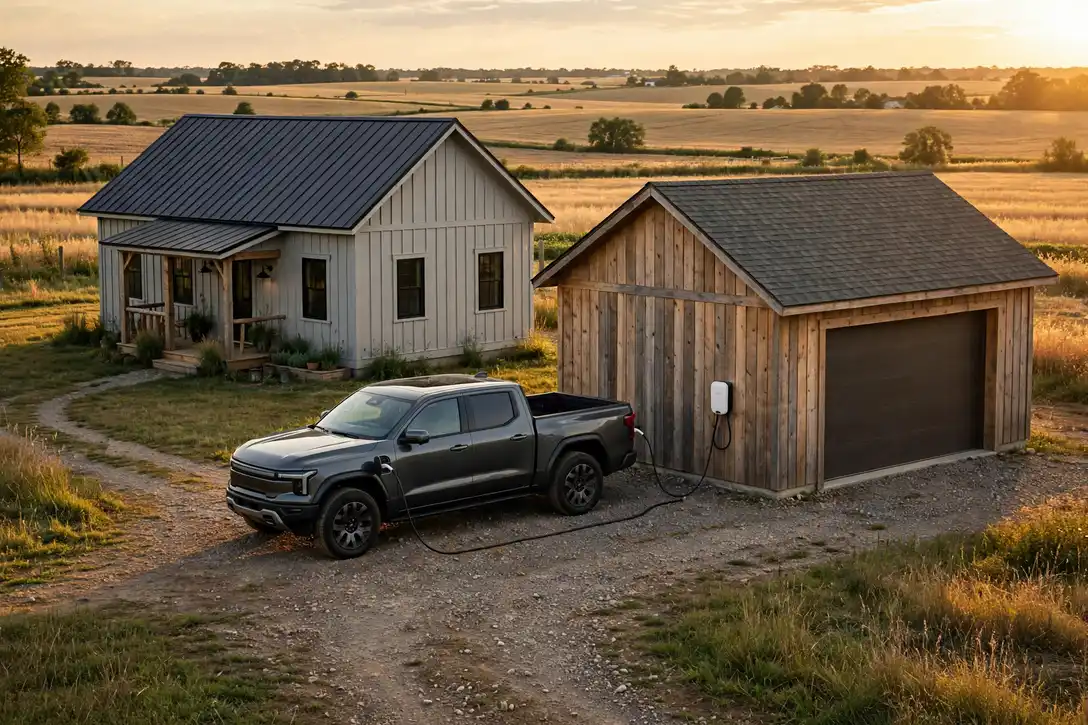
On a compact in-town lot, a charger circuit might run twenty feet from panel to garage wall. On a Clearwater acreage or edge-of-town property, that same circuit might run a hundred feet or more — from a panel in the house, out to a detached garage, or across a yard to a shop building. Longer runs are routine work for an electrician, but they change the design in ways worth understanding.
Distance affects wire size. Electricity loses a small amount of voltage over distance, so longer circuits use heavier wire to keep delivery within spec at the charger. Distance also affects the route: whether cable can run through an attic and down, whether conduit must be buried between buildings, and where trenching, if needed, makes the most sense on your lot. None of this is guesswork — it is exactly what a site evaluation measures.
If your property has an outbuilding, the electrician will also check whether that building already has a subpanel and what feeds it. In some cases the charger can be supplied from the outbuilding's panel. In others, a new circuit from the house is the cleaner answer. Either way, planning the run before installation day is what keeps the project smooth, and it is why Clearwater quotes should always follow a look at the actual property rather than a description over the phone.
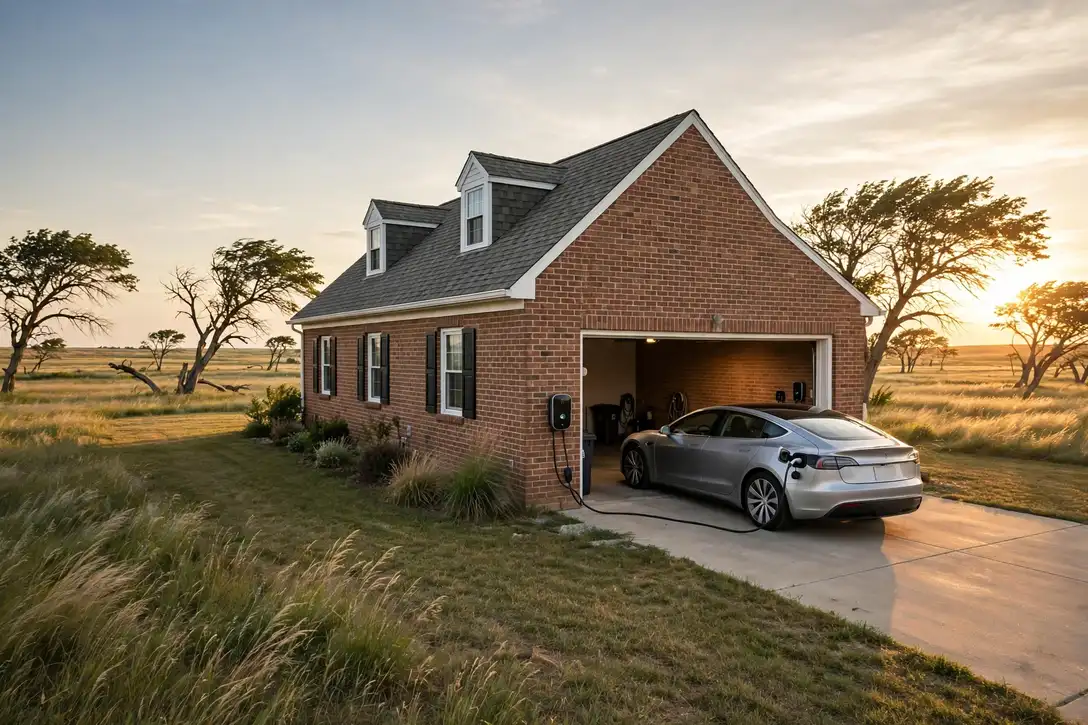
For homes where the car parks in the attached garage as usual, the install is the familiar one: a dedicated circuit and a Level 2 charger on the garage wall. The long-run conversation applies to the many Clearwater homes where parking and power start in different buildings.
Panels in Clearwater Homes

Clearwater's housing stock is mostly single-family homes built across several decades, so panel sizes vary street by street. Some homes have modern 200-amp service with room to spare. Others run on 100-amp panels that serve the house adequately but leave little headroom for a continuous load like a charger.
The electrician's load calculation settles the question for your home. If capacity is tight, the options typically include a panel upgrade, a subpanel, or a charger configured with load management so it shares capacity safely with the rest of the house. Homeowners planning other work — a shop addition, a larger air conditioner, a second EV — should mention it, because panel decisions are cheapest when they are made once.
Homes with a NEMA 14-50 outlet installation already in the garage for an RV or a welder sometimes ask whether the EV can simply use it. Sometimes it can, with the right checks on circuit rating and condition, and the electrician can confirm that during the evaluation rather than assuming.
What Installation Day Looks Like on a Clearwater Property

Installation day starts with a walk of the route. The electrician confirms the panel location, the path the circuit will take, and the exact mounting spot in the garage or outbuilding, then gets to work. For a standard attached-garage install, the rhythm is familiar: power off at the panel, breaker and circuit in, charger mounted and connected, power restored, and a test charge with your vehicle.
For a detached-building install, the day includes the run itself — conduit work, and trenching where the design calls for it. These jobs are planned so the ground work and the electrical work happen in a sensible order, and the electrician will talk through what your yard will look like during and after the work before starting. Most homeowners are pleasantly surprised at how contained it is: a narrow trench line that is backfilled the same day in most cases.
The visit ends with a walkthrough of the charger itself. For residential installations, that means how to plug in and unplug properly, what the status lights indicate, how to set a charging schedule if you want one, and how to coil the cable so the connector stays clean and off the floor — a small habit that matters in buildings that also store mowers and tools.
The K-42 Commute and Overnight Charging

Clearwater's commuters put real miles on their cars. The drive into Wichita via K-42, plus errands and school and family trips, adds up to the kind of daily total where Level 1 charging from a wall outlet starts to fall behind. A car that needs a meaningful charge every night deserves a charger that can deliver it in a few hours, not most of a day.
That is the practical case for Level 2 in Clearwater. You arrive home in the evening, plug in, and the car is ready well before morning — even in winter, when range drops and charging takes a bit longer. Tesla drivers follow the same pattern; the Tesla charger installation page covers the connector and placement details specific to those vehicles.
There is also a resilience angle small towns appreciate. When your fuel is in your garage, a busy week, bad weather, or a change in routine never turns into a detour to find a charger. For households with one car doing all the work, that reliability is often the deciding factor.
Permits in Clearwater
Clearwater is in Sedgwick County, and electrical permits for charger installations here are typically handled through the Metropolitan Area Building and Construction Department (MABCD) or the town's own permit process, depending on the property. In most cases, the electrician who does your installation files the permit and schedules the inspection as part of the job, and confirms which desk applies to your address at the planning stage.
The inspection that follows checks the things that matter for a charger: correct breaker and wire size for the load and the distance, proper grounding, and code-compliant methods where the circuit passes between buildings. Our Wichita permit guide explains the steps in more detail for homeowners who like to read ahead.
Thinking Ahead: Shops and Second Cars
Clearwater properties tend to evolve — a shop gets power this year, a second car arrives next year. A few forward-looking choices during the first install make those steps easier: placing the charger where a second vehicle can reach it and sizing panel work with a future circuit in mind.
Nearby Towns
Compare notes with neighbors in Haysville and Goddard. See the locations page for all communities served, and the EV charger repair page if an existing charger needs diagnosis.
Frequently Asked Questions
Our Clearwater charger needs to go in a detached garage about 80 feet from the house — is that a problem?
It is a common Clearwater setup rather than a problem. The electrician designs the run for the distance, which typically means heavier wire and either overhead or buried conduit between the buildings. Whether the circuit comes from the house panel or from a subpanel in the garage depends on what already feeds the building, and that is decided during the site evaluation.
Can we run power for a charger and future shop tools in the same trench?
Often, yes, and it is smart planning. If trenching is needed for the charger circuit, the electrician can discuss sizing conduit or adding capacity while the trench is open, so a future shop circuit does not require digging twice. Mention any planned outbuilding upgrades at the first visit so the design accounts for them.
We commute from Clearwater to Wichita on K-42 daily — will overnight charging really keep up in winter?
In most cases, yes. A Level 2 charger restores a typical day's driving in a few hours, and even with winter range loss, an overnight session that starts in the evening leaves a full battery by morning. The drivers who struggle are usually on Level 1 outlet charging, where the same recovery can take most of a day.
Our Clearwater home has a 100-amp panel — do we automatically need an upgrade to add a charger?
Not automatically. A load calculation comes first. Some 100-amp homes have enough headroom, especially with a charger set to a moderate rate or equipped with load management. Others benefit from an upgrade, particularly if a second EV or other large loads are planned. The calculation, not the panel size alone, drives the recommendation.
Does a charger in an unheated Clearwater outbuilding work through Kansas winters?
Yes — chargers are rated for garage and outbuilding environments, and EVs charge in unheated spaces all winter. The battery charges a little more slowly when it is very cold, and the vehicle manages that automatically. Keeping the connector holstered indoors and the cable off a damp floor helps the equipment last.
Talk Through Your Clearwater Property
Visit the contact page and Wichita EV Charger will connect you with an independent local electrician who can evaluate your panel, your buildings, and the run between them.