Two Connectors, One Job

At home, both J1772 and NACS carry alternating current (AC) from your charger to the car's onboard charger, which converts it to direct current for the battery. The connector is the physical handshake between cable and car: its shape, its pins, and the communication signals that tell the car and charger how much power to move. Because the electricity itself is the same, a car's home charging speed depends on the circuit and the car's onboard charger — not on which of these two plugs delivers it.
Where the connector matters is fit. A plug only works in the port it was shaped for, unless an adapter bridges the two. So the connector conversation is really a compatibility conversation: what does your current car accept, what will your next car accept, and how do you equip your garage so both answers work?
How J1772 Became the Universal Standard

J1772 is the connector standardized by SAE International and adopted across the industry for AC charging in North America. Through the 2010s and into the 2020s, it was the port on EVs from Ford, Chevrolet, Nissan, Hyundai, Kia, Volkswagen, and essentially every other maker selling in the United States, with Tesla the notable exception. Public Level 2 stations were built around it, and home chargers overwhelmingly shipped with it.
That long run created a deep installed base. Millions of cars with J1772 ports are on the road, public J1772 stations are everywhere, and home chargers with J1772 cables remain widely available. A standard does not vanish when a successor appears; it serves the cars built for it for as long as those cars are driven, which for EVs is a long time.
How NACS Moved From One Brand to an Open Standard
Tesla developed its own connector for its cars and its charging network, a compact plug that handles both AC home charging and DC fast charging through the same port. For years it was proprietary: Tesla cars used it, and everyone else used J1772 for AC and a separate connector for fast charging. That changed when Tesla opened the design and published it as the North American Charging Standard — NACS — inviting other automakers to adopt it.
Adoption followed quickly. Major automakers announced plans to build future models with NACS ports, and the standard was formalized through SAE as well, putting it on the same standards footing as J1772. The practical result for drivers is a transition period: cars on the road and cars on the way carry a mix of both ports, and home charging equipment is sold in both connector versions, sometimes with interchangeable cables.
Adapters: Direction and Ratings Matter
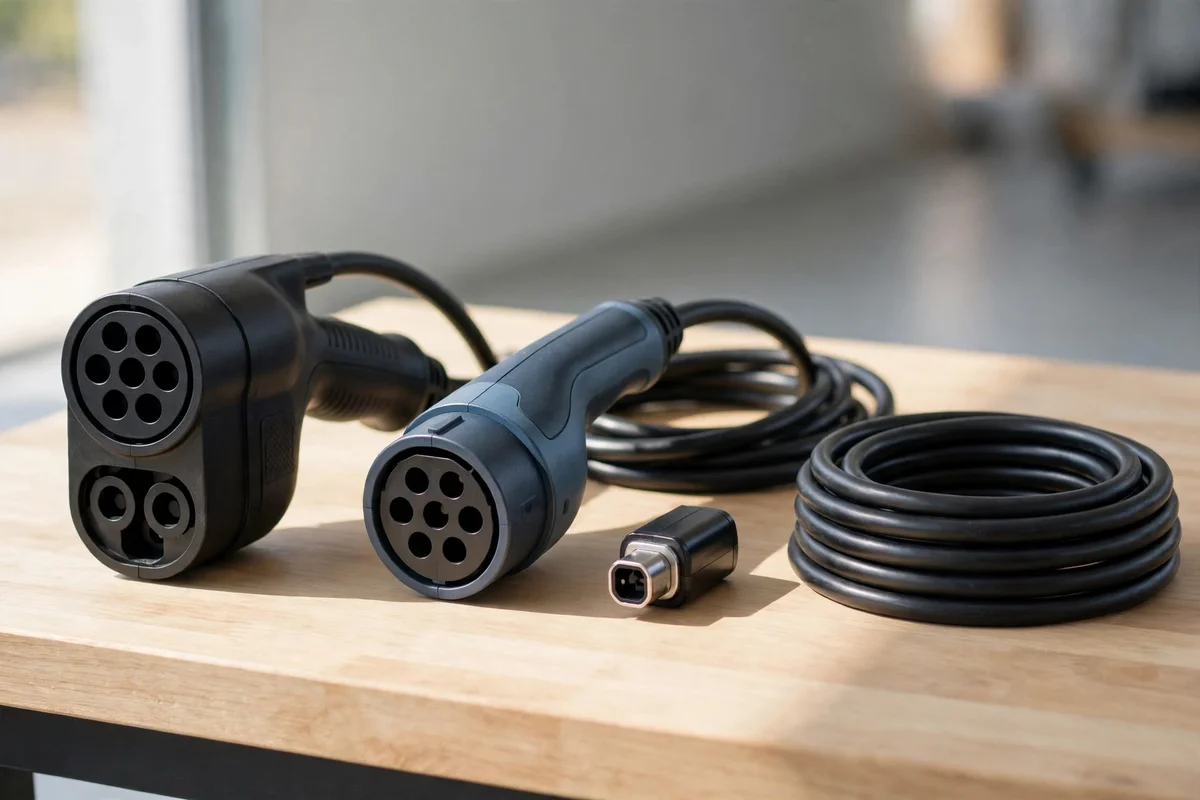
Adapters bridge the two standards, and they work — with two important qualifications. The first is direction. An adapter that lets a J1772 car charge from a NACS-equipped home charger is a different piece of hardware from one that lets a NACS car use a J1772 charger. They are not interchangeable, and buying the wrong direction is a common and avoidable mistake. Check which side is the charger and which side is the car before ordering anything.
The second qualification is ratings. An adapter must be rated for the current and voltage your charging setup delivers, and it should come from the vehicle maker or a reputable equipment manufacturer rather than an unbranded listing from an unknown seller. Home charging runs for hours at high continuous current, which is unforgiving of marginal hardware. Adapters also add a connection point, and connection points are where heat and wear concentrate, so many households treat an adapter as a bridge for a transition period rather than a permanent daily arrangement. If your household will run two different brands for years, a charger with a native connector for the primary car — or a unit with a swappable cable — is usually the cleaner answer. Brand-specific setups, such as those on our Tesla charger installation page, are planned around exactly this question.
CCS and DC Fast Charging: A Separate Note

Fast charging uses different hardware than home charging, and one more connector name belongs in the picture. CCS, the Combined Charging System, extended the J1772 plug with two additional pins for DC fast charging and became the fast-charging standard for most non-Tesla brands. NACS handles fast charging through the same compact port the car uses at home.
For a home installation decision, CCS is background knowledge rather than a buying factor: no home charger uses it, because DC fast charging is public-station equipment, as explained in our guide to EV chargers near me in Wichita. What matters for your garage is only the AC side — J1772 or NACS — and which port your car has.
What to Buy If You Plan to Switch Brands

If your current car has a J1772 port and your next one will likely have NACS, you have three sensible strategies. The first is to install a J1772 charger now and use a properly rated adapter later; the circuit, breaker, and installation work all carry over unchanged, since only the cable end differs. The second is to choose a charger whose cable can be swapped when you change cars, converting the unit itself rather than replacing it. The third, for two-EV households mid-transition, is to plan the circuit generously — a point our panel capacity guide covers — and run the connector mix that matches the cars you actually own today.
What not to do is let connector uncertainty delay the installation itself. The expensive, permanent parts of a home charging project are the circuit and the electrical work described on our Level 2 EV charger installation page. Those are identical for both standards. The connector is the most replaceable part of the whole system, and our guide to replacing or upgrading a charger shows how straightforward that swap is when the time comes.
Frequently Asked Questions
Can I charge a car with a J1772 port on a charger that has a NACS plug?
Yes, with an adapter made for that direction — NACS charger to J1772 vehicle. Confirm the adapter is rated for your charger's output and comes from the vehicle maker or a reputable manufacturer. Many drivers use this setup during a transition between brands, though a native-connector cable is the tidier long-term arrangement for daily charging.
Are adapters safe for daily home charging?
A properly rated adapter from a reputable source is designed for charging use, but it does add a connection point, and connection points deserve respect on a circuit that runs for hours. Inspect it as you would the plug itself, keep it clean and dry, and stop using it if it ever feels warm or loose. For a car you will charge nightly for years, a native cable removes the question entirely.
If I buy a Tesla today, which home charger connector should I choose?
A charger with a native NACS connector matches the car without any adapter, and that is the straightforward choice for a Tesla household. Some chargers are offered in both connector versions or with swappable cables, which can make sense if a second car in the household uses J1772. The underlying circuit work is the same either way.
Will J1772 chargers become obsolete?
No. The number of J1772 cars on the road is enormous, they will be driven for many years, and equipment makers continue to sell J1772 chargers and replacement cables. Standards transitions in the auto industry run on decade timescales. A J1772 charger installed today will serve any J1772 car for its working life, and an adapter extends its usefulness beyond that.
Does the connector change how fast my car charges at home?
No. Home charging speed is set by the circuit's capacity and the car's onboard charger, not by which of these connectors carries the power. A car that accepts a given rate on one connector accepts the same rate on the other through a proper adapter. If speed is your concern, the circuit sizing discussion with your installer matters far more than the plug shape.
The Takeaway

J1772 is the long-standing universal standard; NACS began as one brand's connector and is now an open standard spreading across brands. Both do the same job at home, adapters bridge them when direction and ratings are respected, and the permanent parts of your installation — the circuit and panel work — are identical for either. Choose the connector that matches your car today, keep the transition options in mind if a brand switch is likely, and let the rest of the project proceed. Browse our services and locations, read more on the blog, or reach out through our contact page to plan an installation around the cars in your garage now and next.